
COMPARATIVE ASSESSMENT OF HYDROGEN PIPELINE IMPORT CORRIDORS

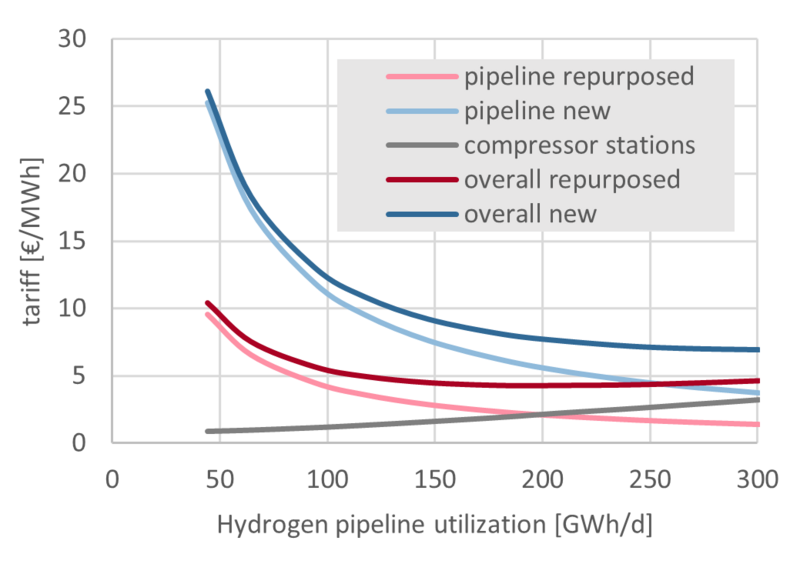
Impact of utilization on required hydrogen pipeline transport tariffs
The European hydrogen economy faces a central challenge: high upfront investments in transport infrastructure coincide with low utilization rates during the market ramp-up phase. Without appropriate regulatory mechanisms, this can lead to disproportionately high transport tariffs, significantly affecting the competitiveness of import corridors.
Within the COMET project ReNEW, an integrated techno-economic analysis of European hydrogen im- port corridors was conducted to systematically quantify transport costs and identify key cost drivers. The model consistently combines regulatory frameworks, financing structures, and physical pipeline parameters. The results show that costs are determined not by distance alone, but primarily by investment structures, tariff design, and utilization levels. Especially in the early market phase, booking and usage effects can significantly influence transport tariffs. At the same time, suitable financing models can mitigate high entry tariffs and accelerate market ramp-up.
Impact and effects
The analysis provides a robust basis for comparing European hydrogen import corridors under realistic funding and ramp-up conditions. It supports companies in making informed decisions on investments, long-term supply contracts, and capacity bookings, while enabling a more transparent assessment of risks. A key finding is the identification of dominant cost drivers and economic levers to actively manage transport costs. Repurposed pipelines, for example, show lower exposure to tariff increases resulting from low utilization than newly built infrastructure.
Fair cost allocation through an amortization model
The evaluation of intertemporal financing approaches demonstrates how high initial tariffs can be avoided and how amortization models enable fair cost distribution regardless of market entry timing and delivery destination of market participants over time, thereby supporting market ramp-up. Beyond its analytical value, the project strengthens Austria’s strategic position within the European hydrogen system and enhances the innovative capacity and international competitiveness of participating partners. By improving transparency in infrastructure investment decisions, it contributes to efficient resource allocation, sustainable value creation, and the development of competitive hydrogen infrastructure in Europe.
| Project coordination Dipl.-Ing. Fabian Radner Team Lead – Hydrogen-based Energy Systems T +43 (0) 316 873 – 9516 radner[at]hycenta.at | HyCentA COMET Center HyCentA Research GmbH Inffeldgasse 15 8010 Graz T +43 (0) 316 873 – 9500 www.hycenta.at |
Project partner
|
|
This success story was provided by the centre management and by the mentioned project partners for the purpose of being published. HyCentA is a COMET Centre within the COMET – Competence Centers for Excellent Technologies Programme and funded by BMIMI, BMWET, the provinces of Styria, Upper Austria, Tyrol, Vienna as well as the SFG. The COMET Programme is managed by FFG. Further information on COMET: www.ffg.at/comet