
AEM LONG-TERM TEST BENCH FOR SINGLE-CELL RESEARCH
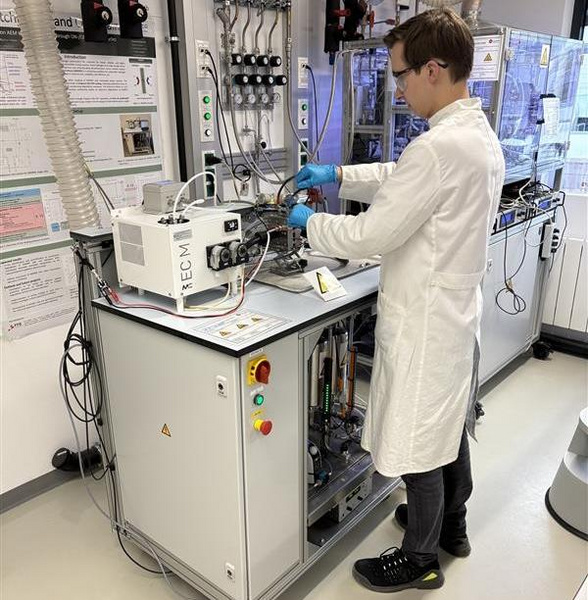
AEM Long-Term Single-Cell Test Bench Copyright: HyCentA Research GmbH
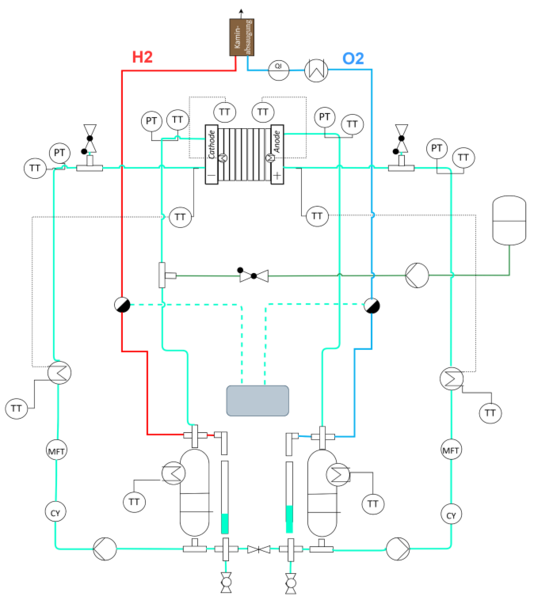
Simplified Scheme of AEM-Single-Cell Test Bench, Copyright: HyCentA Research GmbH
With the growing interest in anion exchange membrane–based electrolyzers (AEMWE), long-term stability of the employed materials is increasingly coming into focus alongside performance. In particular, at the single-cell level, flexible and reproducible test benches specifically designed to investigate degradation mechanisms of catalysts and membranes under alkaline conditions are still lacking. Building on many years of expertise in the electrochemical characterization of electrolyzers, HyCentA Research GmbH developed, within the AniGen project, a specialized AEM single-cell long- term test bench for atmospheric electrolysis conditions. This test bench is specifically designed for long-term operation, accelerated stress tests (AST), and precise electrochemical analyses. The test bench enables investigations on single cells with active areas ranging from 5 cm² to 50 cm² at currents of up to 50 A (extendable to 150 A). Various feed concepts allow both symmetric operation with communicating electrolyte tanks and anodic feed with a dry cathode, enabling operation close to the challenging conditions of industrial standards. A wide operating window with flow rates of 20–300 ml/min, temperatures between 30–80 °C, and KOH concentrations of 0–30 wt.% allows for the systematic variation of relevant operating parameters. Continuous DI water replenishment in the range of 2 μl/h up to a maximum of 20 ml/min enables stable long-term testing. The test bench is further complemented by continuous monitoring of the hydrogen concentration in the oxygen stream, allowing the detection of degradation-relevant gas permeation. The focus of the test bench lies on the investigation of fundamental degradation mechanisms of catalysts. Electrochemical characterization is performed using polarization curves as well as time-resolved voltage/current (U/I) data, enabling the identification of reversible and irreversible aging effects and, if required, can be complemented by impedance spectroscopy.
Impact and effects
The developed AEM long-term test bench provides a highly flexible single-cell testing platform specifically tailored to lifetime and degradation research in the AEM field, enabling systematic investigation of material- and operation-induced aging mechanisms. The robust datasets generated make a significant contribution to the scientific foundation of AEM technology, bridge the gap between short-term performance characterization and industrially relevant long-term requirements, and support the development of durable, cost-efficient electrolysis cells—up to and including technology transfer from single cells to stable AEM stacks.
| Project coordination Rebekka Köll Researcher and Project Lead T +43 (0) 316 873 - 9480 koell[at]hycenta.at | HyCentA COMET Center HyCentA Research GmbH Inffeldgasse 15 8010 Graz T +43 (0) 316 873 – 9500 www.hycenta.at |
Project partner
|
|
|
This success story was provided by the centre management and by the mentioned project partners for the purpose of being published. HyCentA is a COMET Centre within the COMET – Competence Centers for Excellent Technologies Programme and funded by BMIMI, BMWET, the provinces of Styria, Upper Austria, Tyrol, Vienna as well as the SFG. The COMET Programme is managed by FFG. Further information on COMET: www.ffg.at/comet