
3D-CFD SIMULATION OF LH₂ REFUELING WITH PRESSURE-CONTROLLED BOIL-OFF VALVE
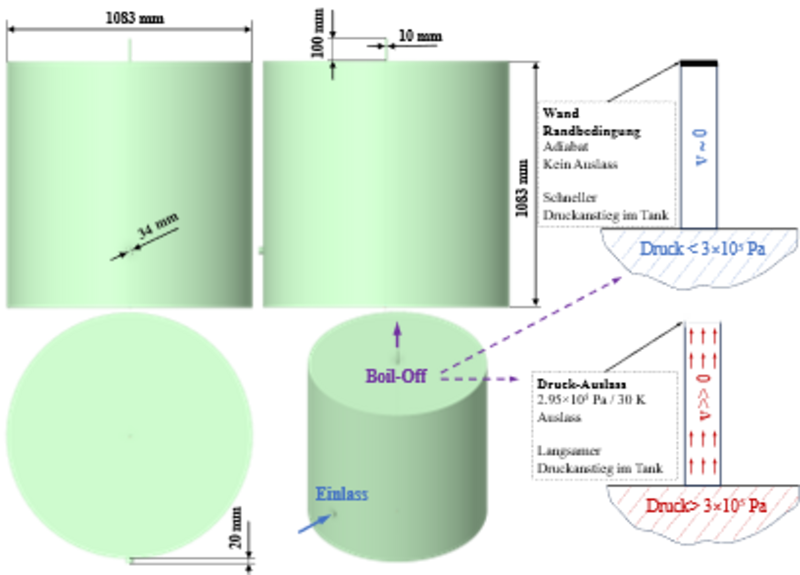
Liquid Hydrogen Tank Geometry with Boundary Conditions of the Boil-Off Valve ©HyCentA
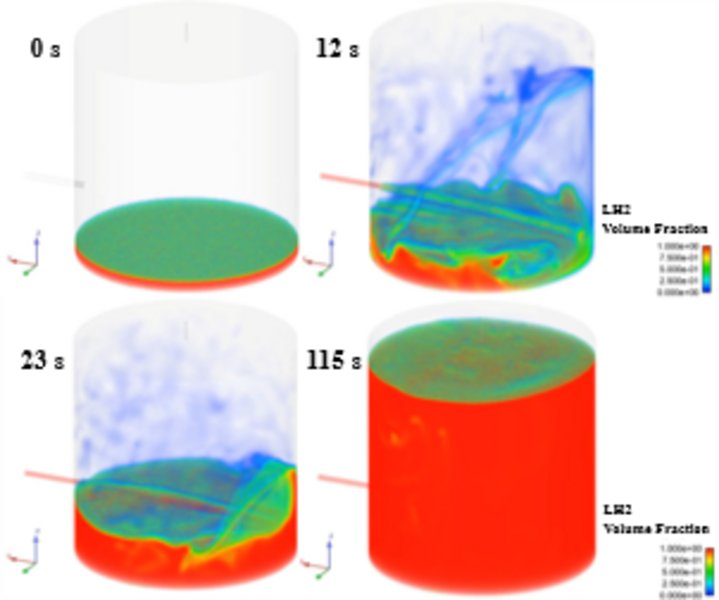
LH2-Volume Fraction during Simulation ©HyCentA
Liquid hydrogen (LH₂) is becoming increasingly important as a key element in future energy strategies, particularly in sectors with high demands for energy density and range, such as aerospace, shipping, and heavy-duty transport.
While the cryogenic properties of LH₂ provide significant advantages in terms of energy density, they also present major challenges in storage and refueling due to the extremely low temperatures and boil-off losses. To address these challenges, this project developed an advanced CFD-based simulation methodology for transient LH₂ refueling processes.
The main objective was to develop a robust, transferable simulation framework capable of modeling dynamic phase transitions, pressure changes, and the development of gas and liquid phases in real-time. The methodology combines the Volume-of-Fluid (VOF) method with the Lee phase-change model and utilizes finely resolved Real Gas Property (RGP) tables to ensure thermodynamic accuracy. Particular focus was placed on implementing an automated boil-off management strategy, which enables physically consistent pressure regulation and venting behavior. Additionally, the automatic mesh refinement was integrated to precisely capture phase boundaries while improving computational efficiency.
The developed simulation tool enables accurate modeling of refueling processes and phase transitions under varying operational conditions, providing a crucial foundation for the optimization of storage systems and refueling processes. The results support the future development of efficient, safe, and scalable LH₂ technologies.
Impact and effects
This project plays a critical role in overcoming technological barriers to the storage and refueling of liquid hydrogen. By closely linking simulation and validation, it advances the understanding of complex phase change processes and allows for more precise infrastructure design. The developed methodology not only serves as a foundation for optimizing liquid hydrogen systems but also provides a transferable tool for both research and industry, contributing to the efficient scaling of hydrogen technologies. The modular nature of the simulation allows for easy adaptation to different use cases, facilitating the transition from research to practical application. As a result, this methodology offers valuable support for the future integration of LH₂ as a key energy carrier in zero-emission mobility and beyond.
| Project coordination Dr. Nejc Klopčič, MBA Project Lead T +43 (0) 316 873 9492 klopcic[at]hycenta.at | HyCentA COMET Center HyCentA Research GmbH Inffeldgasse 15 8010 Graz T +43 (0) 316 873 – 9500 www.hycenta.at |
Project partner
|
|
This success story was provided by the centre management and by the mentioned project partners for the purpose of being published. HyCentA is a COMET Centre within the COMET – Competence Centers for Excellent Technologies Programme and funded by BMIMI, BMWET, the provinces of Styria, Upper Austria, Tyrol, Vienna as well as the SFG. The COMET Programme is managed by FFG. Further information on COMET: www.ffg.at/comet